Learned potentials that generalize to unexplored composition space
AstraIQ's screening models are built on graph neural network architectures trained on large-scale DFT datasets and iteratively refined with active learning on synthesis feedback.
The model stack
Graph neural network backbone
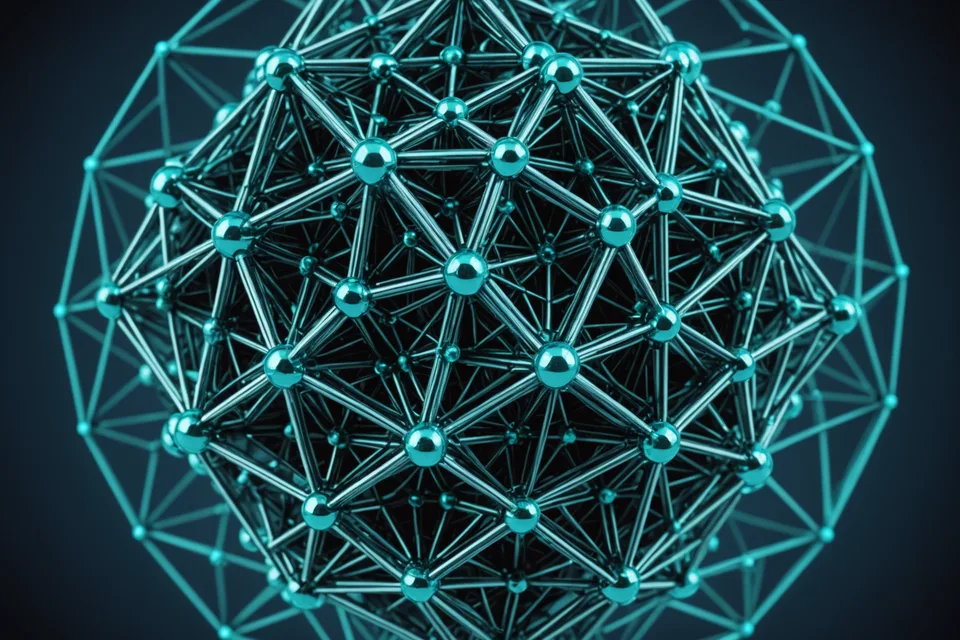
Crystal structures are represented as graphs: atoms as nodes, bonds as edges with distance and angular features. Message-passing over this graph lets the network learn atomic environment representations that transfer across composition space.
Fine-tuned interatomic potentials
Starting from a foundation model trained on the Materials Project and OQMD, we fine-tune on element families relevant to each application domain. Based on our internal benchmark evaluations against held-out DFT reference structures, formation energy prediction errors are typically below 50 meV/atom for in-distribution compositions. Ask us for the full benchmark report.
Active learning from synthesis
Characterization data from synthesis runs enters the training loop. A query strategy based on prediction uncertainty prioritizes which new structures enter the DFT queue, so the model improves in the composition regions where it is being used.
Where MLIPs break and how we handle it
Learned potentials interpolate from training data. When a candidate structure lands outside the training distribution, prediction uncertainty rises. AstraIQ flags these cases in the screening output rather than treating high-uncertainty predictions as reliable.
Want to discuss the technical approach?
We publish technical notes on the blog and welcome conversations with research teams working on related problems.
Get in touch