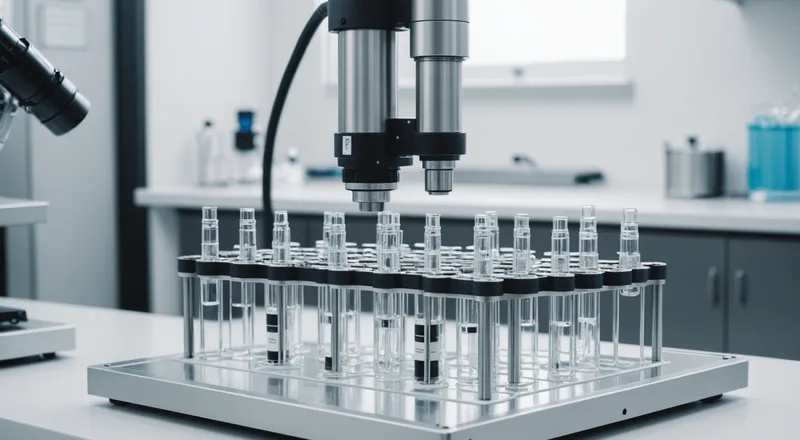
Lab automation for solid-state chemistry has matured considerably over the past decade, but the gap between what vendors demonstrate and what reliably works in a production inorganic synthesis workflow is still significant. This is a description of where current lab automation hardware delivers genuine value in solid-state synthesis, where it falls short, and what that means for designing a closed-loop discovery workflow around automated synthesis rather than around theoretical capability.
The focus here is on solid-state synthesis routes: powder precursor handling, mixing, pressing, and high-temperature furnace processing. Wet chemical routes (co-precipitation, sol-gel, hydrothermal) have different automation profiles, different failure modes, and different degrees of commercial readiness. Some of what is described here applies across routes, but the specifics are different enough that they warrant separate treatment.
What Solid-State Automation Handles Reliably
Powder Weighing and Dispensing
Gravimetric powder dispensing, meaning automated weighing and dispensing of precursor powders into synthesis vials or crucibles, is the most mature component of solid-state automation. Commercial dispensing systems achieve weighing accuracy of plus or minus one to two milligrams at gram-scale batch sizes, which is adequate for most inorganic synthesis targets where stoichiometry is specified to two significant figures. For synthesis targets that require tightly controlled cation ratios (specific NMC compositions, for example, where the Ni:Mn:Co ratio affects electrochemical properties), a two-milligram error on a five-gram batch introduces roughly 0.05 percent stoichiometric uncertainty, which is acceptable.
The caveat is that powder handling characteristics vary enormously between precursors. Hydroscopic salts, highly cohesive fine powders, and materials with significant electrostatic charging all require specific handling procedures that standard dispensing hardware does not always handle gracefully. In practice, a dispensing workflow needs a characterization step for each new precursor to assess flowability and electrostatic behavior before it can be reliably included in an automated protocol. This is a one-time characterization cost per precursor, not a recurring issue, but it means you cannot simply add a new precursor to the library without validation work.
Mixing
Ball milling automation is well-established. Programmatic control over milling duration, ball-to-powder ratio, rotation speed, and solvent addition is standard on current-generation mill hardware. For most oxide and phosphate precursor systems, ball milling produces reproducible particle size distributions and mixing homogeneity as long as the precursors are not reactive with each other under milling conditions and the milling parameters are validated for the specific precursor set. The automation value is in reproducibility across runs, not in discovering new milling conditions, which still requires protocol development work.
Furnace Scheduling
Programmable furnace controllers with multi-segment temperature profiles have been standard for decades, and connecting those controllers to a scheduling system is straightforward. Running multiple sequential synthesis batches through a furnace queue according to a programmatic schedule is reliable. The scheduling reliability depends on the furnace hardware behaving consistently, which in practice means regular thermocouple calibration checks and periodic verification that the actual temperature profile matches the setpoint profile. Furnace drift over time is real and affects reproducibility more than most teams account for in automation planning.
What Solid-State Automation Cannot Do Reliably
Interpreting Characterization Results
This is the most significant gap between what automation can do and what a closed-loop discovery workflow requires. An X-ray diffractometer can acquire a pattern automatically. Parsing that pattern to identify the phases present, assess phase purity, and determine whether the synthesis produced the intended target requires judgment that is not currently reliable in fully automated form for anything other than straightforward cases.
For a synthesis target that matches a well-characterized reference phase closely, reference pattern matching software performs well. For novel compositions that may exhibit modified lattice parameters, impurity phases that are not well-represented in reference databases, or ambiguous peak assignments where two plausible phases produce similar patterns, automated interpretation fails in ways that are not always visible in the output. The software will produce a phase assignment, but the confidence in that assignment is not reliably communicated to the downstream workflow. A human materials scientist looking at the same pattern would flag the ambiguity and flag it correctly; the automated system may not.
In our current workflow, XRD interpretation is the step that is most explicitly not automated. The pattern acquisition is automated, and basic quality checks (background subtraction, peak detection, comparison against the target structure's reference pattern) run automatically. But the final judgment on whether the synthesis was successful enough to advance the candidate to the next step requires a person. We are working on improving the confidence estimation and flagging in the automated analysis, but we are not claiming it is solved.
Adaptive Parameter Feedback Loops
An adaptive synthesis loop, where characterization results from one batch directly modify the temperature profile or dwell time for the next batch, is technically feasible to implement as software. The challenge is that the parameter-outcome relationship for solid-state synthesis is not well-characterized enough to use an automated model reliably without human oversight, except in the narrow case where you have extensive prior data on a specific composition family and the parameter space is well-explored. For novel compositions, the parameter space exploration is part of the synthesis development work, and automating that exploration without judgment leads to many failed runs before the system converges.
In practice, parameter adaptation in our workflow is semi-automated: the system flags batches where characterization results fall below quality thresholds and proposes parameter adjustments based on prior runs in the same composition family, but a human reviews and approves the proposed change before the modified protocol runs. This is slower than a fully automated adaptive loop but produces substantially fewer wasted synthesis runs on novel chemistry.
What This Means for Closed-Loop Workflow Design
The implication for closed-loop workflow design is that you cannot treat synthesis automation as a black box that receives a candidate list and returns characterization results. The feedback loop is reliable for the dispatch and acquisition steps, and requires human involvement at the characterization interpretation and parameter adaptation steps. A well-designed workflow makes the human-in-the-loop steps explicit, with clear decision points where human judgment is required, rather than building a nominally automated workflow where human intervention happens informally when automated steps fail.
For teams evaluating whether lab automation makes sense for their synthesis program: the honest answer is that it delivers clear value for multi-batch throughput with well-characterized chemistry and minimal value for single-batch exploration of genuinely novel chemistry. The crossover point depends on how many synthesis attempts per candidate you typically run and how well your characterization targets are defined. If you are running three or four synthesis attempts on each candidate to explore parameter space, automation delivers throughput benefits. If each synthesis is a unique exploration where the parameters are determined by the results of the last one, the automation value is lower.
The closed-loop vs open-loop article discusses the broader workflow design question, including where automated and human-guided discovery are each more productive. If you want to discuss how synthesis automation would interact with your specific synthesis protocols and characterization requirements, reach out to the team.